


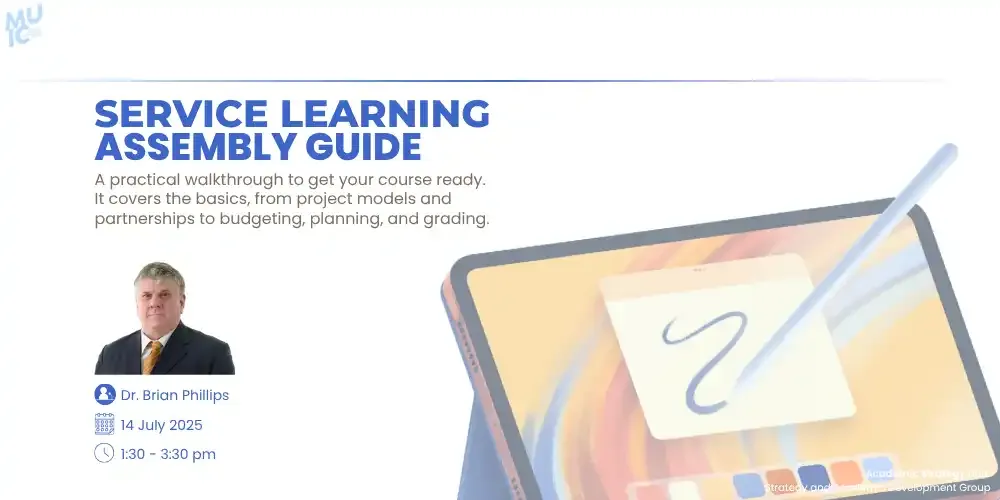
Title: Service-Learning Assembly Guide
Date & Time: Monday, 14 July 2025 from 1:30 - 3:30 pm
Venue: Via Zoom
Conductors: Dr. Brian Phillips
On July 14, 2025, Dr. Brian Phillips led a workshop titled Service-Learning Assembly Guide, offering a practical walkthrough for lecturers aiming to design impactful service-learning courses. Held via Zoom, the session focused on structuring service-learning projects, forming community partnerships, managing logistics, and integrating AI tools to streamline course development.
Service-learning courses are built around real-world engagement, where students apply academic knowledge to benefit communities. The workshop outlined two primary project types: community-based research, which involves identifying and analyzing local issues with partners, and project-based service, where students complete tangible projects. These can be structured as term projects, which are short and manageable, or ongoing projects, which span multiple terms and allow for deeper impact and stronger relationships. While term projects offer quick results and are easier to manage, ongoing projects require long-term commitment and coordination across student groups.
A key highlight of the workshop was the use of AI tools—such as ChatGPT, Gemini, and Copilot—to assist lecturers in course design. These tools can act as a secretary, organizing course components; a student assistant, generating ideas and content; and a consultant, offering expert suggestions. Dr. Phillips introduced three prompting techniques to maximize AI effectiveness: system prompting (setting the overall task), contextual prompting (providing details), and role prompting (assigning the AI a persona, such as a curriculum designer).
For example, a lecturer might prompt:
“Help me develop a service-learning course, 2 hours/week for 12 weeks. I teach first-year undergraduates at an international college in Thailand. The students are 17–20 years old, non-native English speakers.”
With this input, AI can generate a full syllabus, including course title, credits, goals, weekly schedule, project ideas, and assessment plans. It can also help draft project proposals and elevator pitches for community partners, even translating them into Thai for local engagement.
The workshop emphasized the importance of local partnerships, recommending collaboration with nearby organizations to reduce safety risks and logistical challenges. Suggested partners included sections within MU, MUIC, student clubs, and local institutions such as Rachasuda College and Don Wai Market. Example projects ranged from anti-vaping campaigns to animal welfare initiatives and sustainability efforts.
Assessment in service-learning courses typically may include exams (10–25%), project deliverables (15–35%), and MU literacy components—short self-study videos followed by quizzes. Lecturers must also allocate a budget for material fees and field trips, with clear protocols for safety and documentation.
In conclusion, the Service-Learning Assembly Guide provided a comprehensive framework for designing service-learning courses that will be offered more frequently starting in the next academic year. By leveraging AI tools and focusing on local partnerships, lecturers can create dynamic learning experiences that benefit both students and the surrounding community.