As Thailand's leading liberal arts college, Mahidol University International College takes pride in its long General Education tradition.
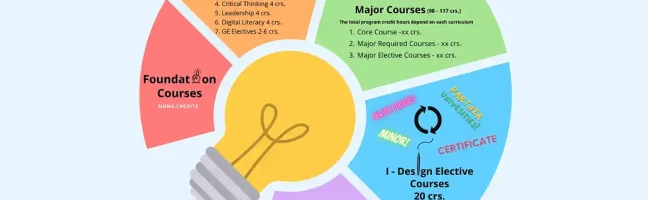
General Education at MUIC combines foundational knowledge and skills with innovative learning for the 21st Century.
The flexible and diversified curriculum allows students to pursue their interests and express their individualities.
General Education is a core requirement for students from all majors and is the first step to making students well-rounded graduates.

Based on their achievement on the essay portion of the MUIC entrance exam, students whose English placement is below ICGC 101 Academic Writing and Research I will be placed into the "ERS Track". These students will be required to take ICME 100 English Resource Skills and pass the course with the grade of "S" before moving to ICGC 101 Academic Writing and Research I.
Develop a voice in written and spoken English that can be adapted to different audiences in particular social, academic, and artistic contexts as well as unique and informed opinions about issues related to, but not exclusive to, one's major.
Communicators are self-directed and reflective learners who apply critical and creative thinking to overcome challenges as active team members and collaborators in knowledge development and production.
Based on their achievement on the essay portion of the MUIC entrance exam, students will be placed into 3 following tracks: 'ERS Track', 'GC1 Track' and 'GC2 Track'.
Develop self-awareness of physical, mental and emotional wellbeing through experiential learning.
Life appreciators explore and develop behaviours and a mindset towards an appreciation of a creative healthy, active, sustainable lifestyle.
Explore the current state of the world, including language, culture, geography, economics, politics and environment, the interconnection of local and global issues, as well as the common challenges that we are facing.
Global citizens aim to promote an understanding of diverse cultures and beliefs, and how these institutions influence people's behaviour and shape societies around the globe.
Explore thinking processes and practice, different methods of data collecting and management, how to make a logical and ethical judgement, ways to formulate solutions to the unanswered, and ways to express opinions and ideas through creative communication.
Critical thinkers develop an ability to analyse problems, propose informative solutions that incorporate a variety of perspectives and achieve progressive results.
Understand how to drive change for the benefit of society and enhance interpersonal skills, critical thinking, and creativity in real-life situations.
Leaders aim to instill a sense of altruism, harmony, and social responsibility in the students. They learn to work collaboratively at an early stage of their professional life. This is done through discussion, problem analysis, and projects that address community needs.
Act appropriately and ethically in an online environment and culture. Digital literacy provides an understanding of online safety, digital culture and its influence on society, the implementation of media and data ethics in an online environment.
Digital literates develop abilities to navigate, communicate and collaborate through online platforms, as well as to evaluate the validity and authenticity of the wealth of information available online.